UK Service Interval Research 2026: What Carmakers Publish
Research on 406 engines: a carmaker-published cambelt interval for only 18 of 106 belt-driven engines, and one badge's oil service intervals can differ 2x.
George Arnold · Founder & Vehicle Data Expert
Published 6 October 2026
Written by George Arnold
Related reading
Full Service History vs Full Main Dealer History: What's the Difference?
FSH vs FMDSH explained: what full main dealer service history means, whether it's worth more than independent history, and how to verify the claim by VIN.
Car Service Intervals Explained: How Often to Service a Car
How often should you service your car, and what service does it need? UK intervals explained: time vs mileage, and interim vs full vs major services.
Service History & Your Car Warranty: How Gaps Can Cost You a Claim
A missed service can give a warranty provider grounds to reject a claim. How service history affects manufacturer, approved-used and aftermarket cover.
Key findings (free to cite with attribution to FindServiceHistory):
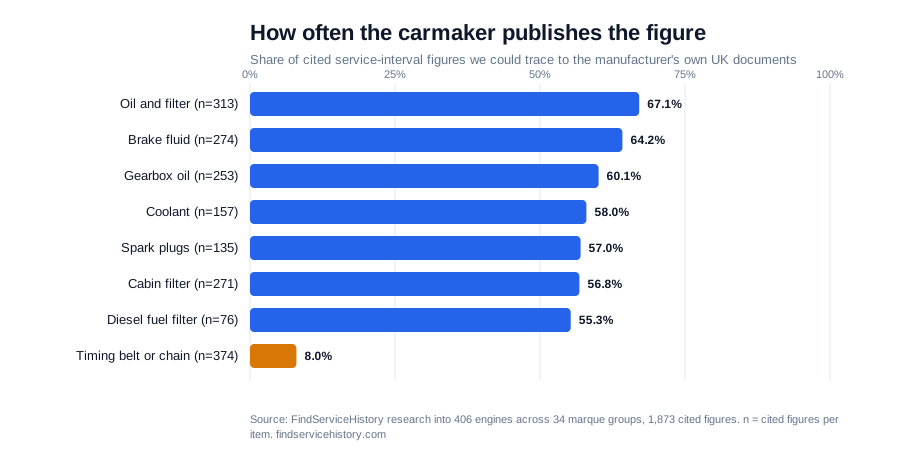
- Cambelt intervals are the least published part of a service schedule. Only 8% of timing belt and chain figures (30 of 374) could be traced to the manufacturer's own UK documents, against 55–67% for oil, brake fluid, gearbox oil, coolant, plugs and filters.
- For only 18 of 106 belt-driven engines did we find a cambelt interval published by the carmaker. For 34 we found no replacement interval from any source at all.
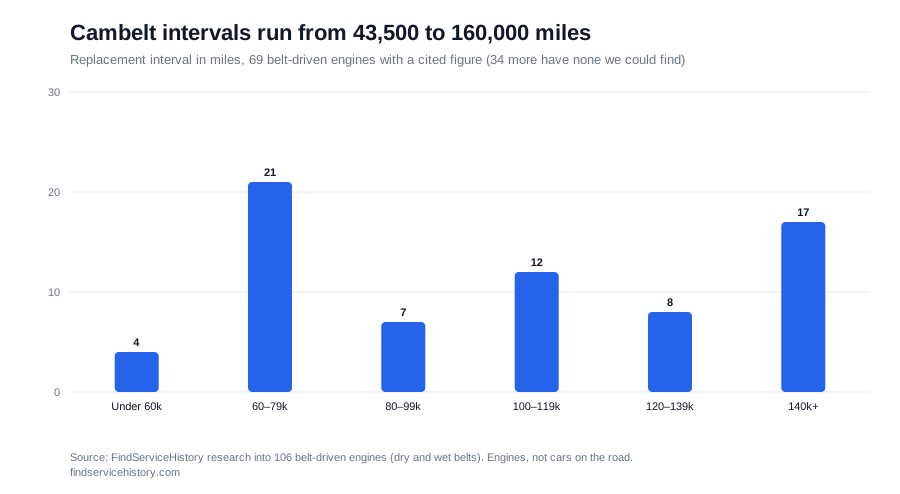
- Cambelt intervals run from 43,500 to 160,000 miles (median 100,000), with time limits from four to ten years.
- Almost a third have changed. 32 of the 106 belt intervals (30%) have been revised by the manufacturer at least once, so a figure read a few years ago may now be wrong.
- One badge, two intervals. Kia, Hyundai and Vauxhall each publish a 10,000-mile oil service for some engines and a 20,000-mile one for others; Jaguar runs from 10,000 to 21,000 miles.
- Seven in ten engines in our dataset use a timing chain (266 of 374 with a known drive). Twelve run their belt in oil, and twelve have both a belt and a chain.
Why we did this
Our free service schedule checker tells a driver what their car needs and when, from the registration. To build it we researched the service schedule of every higher-volume engine sold in the UK, item by item, and attached a source to every figure. Doing that showed us something we had not expected: for the single most expensive item on most schedules, the cambelt, the carmaker's own figure is usually nowhere a driver can find it.
Method
The dataset covers 406 engines across 34 marque groups, from roughly 2005 to today, and 1,873 cited figures for oil, brake fluid, coolant, gearbox oil, spark plugs, filters and the timing drive. Every figure carries a source. Sources are graded in two: a figure is manufacturer-published when it comes from the brand's own UK website or documents; everything else is reported — a UK dealer group reproducing the schedule, a belt manufacturer's catalogue, or the trade press. Forum figures were not accepted without a better source behind them, and our own sites were never used as a source.
Two things to keep in mind when reading the results. These are engines, not cars on the road: a share here is a share of engine families, not of the vehicles you see in a car park. And "not published" means we could not find it in the manufacturer's own public UK documents — the figure may still be printed in the owner's handbook or held in the dealer's system.
Cambelts are the least published part of the schedule
For routine items, manufacturers publish their figure more often than not. Oil service intervals came from the carmaker's own UK documents 67% of the time, brake fluid 64%, gearbox oil 60%. For the timing drive it was 8%.
Narrow it to belt-driven engines and the picture is starker. Of 106 belt-driven engines, the manufacturer's own UK documents gave a cambelt interval for 18. For 54 more, the interval comes from a UK dealer group, a belt maker or the trade. For 34 we found no replacement interval from any source — the manufacturer either treats the belt as inspect-only or publishes nothing.
Volkswagen Group is the clearest example. None of its UK brand websites gives an engine-specific cambelt interval. Volkswagen UK tells owners to change the cambelt "each time your vehicle reaches its recommended mileage" without saying what that is, and Audi UK gives a range of 80,000 to 140,000 miles. Until July 2023, UK retailers applied a blanket four-to-five-year rule; that has since been withdrawn in favour of intervals set per vehicle — but dealer pages still online quote the old rule.
For 13 of the 34 marque groups, including Mercedes-Benz and Nissan, we could not trace a single figure of any kind to the manufacturer's own public UK documents.
Check a vehicle's service history
Retrieve official manufacturer dealership service records using just a registration number. Results typically arrive within minutes. Your card is authorised but not charged unless we find records.
Run a Service History Check — £9.99No charge unless we find records
Cambelt intervals vary by a factor of almost four
Where a replacement mileage is cited, it runs from 43,500 miles (Renault's 2.0 16v and 2.0 TCe petrol) to 160,000 miles (Hyundai and Kia's current 1.6 and 2.2 CRDi diesels, and VW Group's EA189 2.0 TDI), with a median of 100,000. Time limits run from four to ten years. There is no "usual" cambelt interval to fall back on.
Almost a third have been changed. 32 of the 106 belt intervals (30%) have been revised by the manufacturer at least once. Ford, for example, originally gave its 2.0 EcoBlue diesel — whose belt runs in oil — 10 years or 150,000 miles, then cut it to 6 years or 100,000 miles by service bulletin. Fiat moved several of its petrol and MultiJet belts from five years to six. A figure that was right when someone wrote it down may not be right now.
The stakes are high on many of these engines. For 30 of the 106 we confirmed the engine is an interference design, where a snapped belt lets the valves and pistons collide and can wreck the engine. For most of the rest the question is simply unanswered in any source we could find.
Two newer designs complicate things further. Twelve engines run their belt in oil — a "wet belt", such as Ford's 1.0 EcoBoost and the PSA 1.5 BlueHDi diesel — whose life depends on the right oil being used. And twelve engines have both a belt and a chain, so the answer to "belt or chain?" is "both". Seven in ten engines in the dataset use a chain (266 of 374 with a known drive), which normally has no scheduled replacement. Our cambelt or chain list gives the answer engine by engine.
The figure you find online may belong to another country
Carmakers publish different schedules in different markets, and the figure that gets repeated is not always the UK one.
- Subaru EJ boxer engines. The UK cambelt interval ran from 45,000 to about 66,000 miles depending on the year and whether the engine was turbocharged. The figure widely repeated online is the US one, 105,000 miles. On an interference engine, following the US figure means changing the belt tens of thousands of miles late.
- Ford 1.0 EcoBoost. The commonly quoted 10 years or 100,000 miles for its wet belt comes from Ford's US schedule. The UK handbook figure is 10 years or 150,000 miles.
- Volkswagen Group. The four-to-five-year UK rule still quoted on dealer pages was withdrawn in July 2023.
We have been caught by this ourselves: before we sourced every figure, our own earlier tables carried market-specific numbers that were wrong for the UK. That is why every figure in our schedule checker now links to the source it came from.
One badge, several intervals
Even for oil services, which carmakers publish most often, the interval belongs to the engine, not the badge. Comparing the manufacturer-published, normal-use oil-service mileage across each brand's own car engines (vans and special regimes such as Longlife or severe use left out):
| Brand | Engines compared | Shortest | Longest |
|---|---|---|---|
| Jaguar | 5 | 10,000 mi | 21,000 mi |
| Toyota | 15 | 6,000 mi (GR Yaris) | 12,500 mi |
| Hyundai | 15 | 10,000 mi | 20,000 mi |
| Kia | 13 | 10,000 mi | 20,000 mi |
| Vauxhall | 9 | 10,000 mi | 20,000 mi |
| Ford | 5 | 12,500 mi | 18,000 mi |
| Fiat | 14 | 9,000 mi | 12,500 mi |
At Hyundai the split is by fuel: every current petrol is serviced every 10,000 miles and every diesel every 20,000. At Kia it goes engine by engine — the 1.6 GDi petrol is a 20,000-mile car, the turbocharged 1.6 T-GDi a 10,000-mile one, and even its two 1.6 CRDi diesels differ, at 20,000 and 10,000 miles. By contrast Mazda, MG, Mitsubishi, Porsche and Volvo publish one oil-service mileage across every engine we compared. The practical lesson is the same either way: look up the schedule for the engine, not the brand.
What this means for drivers and buyers
- Find your engine's own interval. Our free schedule checker works from the registration and shows the source behind each figure. For the cambelt, a franchised dealer can give the interval for your specific car from its VIN.
- Be suspicious of a single round number. "Every five years or 60,000 miles" is not a rule; for any given engine it may be early, late or simply out of date.
- On a used car, check that the belt was actually changed. A cambelt change is one of the most expensive items on a schedule and one of the easiest to skip. Look for it in the service history and on invoices, and read our guide to cambelts and service history.
- On a wet-belt engine, the oil matters. Its belt sits in engine oil, so the right specification at the right interval is part of looking after the belt.
Caveats and limitations
- Engines, not cars. The dataset is engine families from 34 marque groups, weighted towards the higher-volume engines sold in the UK from about 2005. It is not a sample of the vehicles on the road.
- "Not published" means not found in public documents. Research ran to roughly 150 searches per marque group. A figure may exist in a handbook or a dealer system we could not read.
- Reported is not unreliable. Many reported figures come from UK dealer groups reproducing the official schedule, or from belt manufacturers' catalogues. The grading says where a figure came from, not whether it is right.
- The dataset grows. Research is added regularly, so totals will change. Always cite a figure with the number of engines behind it.
Use this data
These findings are free to cite with attribution to FindServiceHistory and a link to this page. Suggested attribution:
Source: FindServiceHistory research into the UK service schedules of 406 engines across 34 marque groups (October 2026).
For a figure on a specific engine or brand, email research@findservicehistory.com. More of our research is in the press room.
Check a vehicle's service history
Retrieve official manufacturer dealership service records using just a registration number. Results typically arrive within minutes. Your card is authorised but not charged unless we find records.
Run a Service History Check — £9.99No charge unless we find records